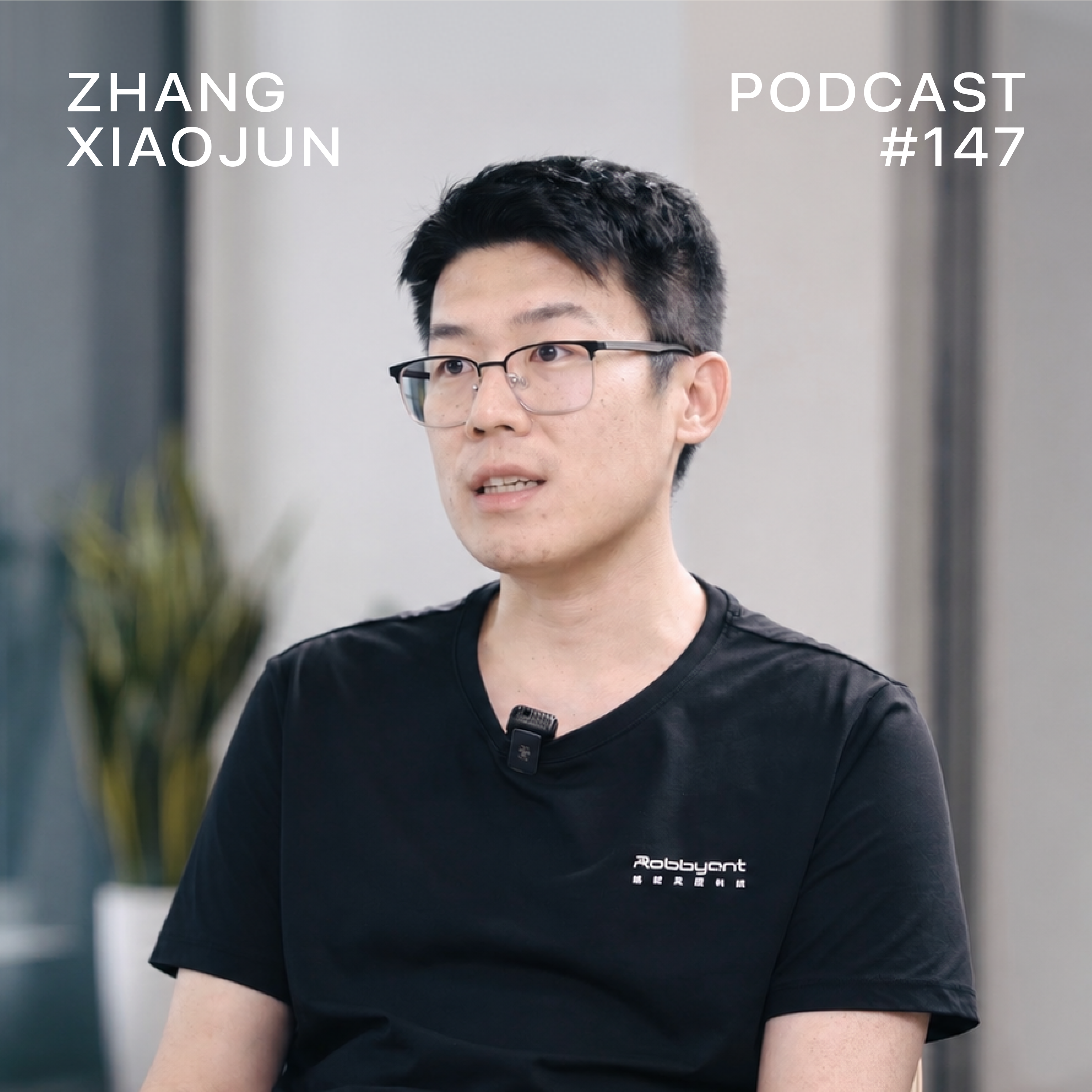
Shen Yujun, Chief Scientist at Ant Group's spin-off Linbo, discusses the company's mission to build a robot-native foundation model—a 'brain' designed from scratch for physical-world tasks, not adapted from digital models. The conversation covers the evolution from GANs to diffusion models, the critical importance of real-world sensor data for scaling, and the debate between soft-hardware integration versus pure brain development. Shen also shares insights on the current state of embodied intelligence, the need for million-hour-scale data to achieve a GPT-1 moment for robots, and his experience as a student of the late Professor Tang Xiao'ou.

Summarized by Podsumo
Shen Yujun, Chief Scientist at Ant Group's spin-off Linbo, argues that building a truly effective robot brain requires a **robot-native foundation model** designed from scratch for physical-world tasks, not adapted from digital models.
The key bottleneck to achieving a GPT-1 moment for robotics is **data scaling**—the industry needs millions of hours of real-world sensor data, which is currently far from sufficient (current data is at tens of thousands of hours).
Linbo's VLA 2.0 model introduces a **MoE (Mixture of Experts) architecture** and a **causal, single-directional attention mechanism** for real-time control, eschewing the bidirectional design common in digital-world models.
Shen emphasizes that the current **primary bottleneck is intelligence (the brain), not hardware**, reversing the earlier assumption that Chinese robotics teams focused more on hardware.
The ultimate goal is for robots to enter homes, but this requires first solving the data challenge, then developing task generalizability, and finally achieving a multi-ecosystem of robot brains (similar to the LLM landscape).
"I am very convinced that embodied intelligence must have its own model—a model designed for embodiment. But this view is conditional on the premise that data must support it to build its own model."
— Shen Yujun
"Entrepreneurship is definitely a gamble. No one knows which path will succeed, and resources are always limited. So in the face of uncertainty with limited resources, you have to bet."
— Shen Yujun
"The highest best expectation is that I really see robots entering homes, and the robots that enter homes run Linbo's model. The worst expectation is that we didn't achieve it."
— Shen Yujun