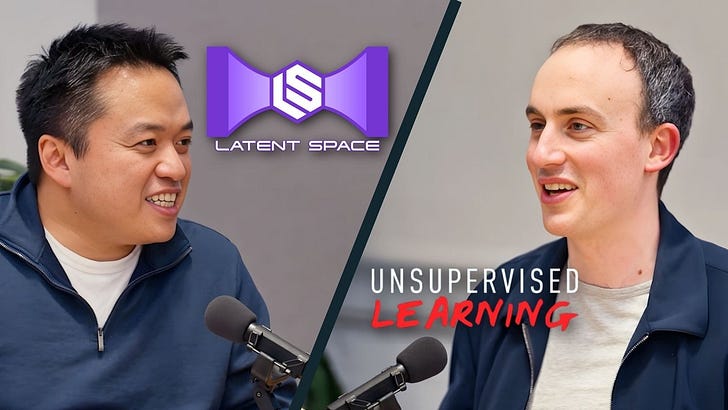
This episode of Latent Space, a crossover with Unsupervised Learning, debriefs AIE Europe and explores the "AI coding wars." The discussion highlights the massive and rapidly evolving AI coding market, the thesis of coding agents "breaking containment" in 2026, and the shift towards capability exploration over efficiency. Key topics include infrastructure stability, the rise of open models and custom chips, and the challenges and opportunities of selling to AI agents.

Summarized by Podsumo
The AI coding market is experiencing massive growth, with major players like Anthropic and OpenAI generating billions in ARR, indicating a phase of capability exploration where creativity and spending are rewarded.
A key thesis for 2026 predicts "coding agents breaking containment," expanding beyond software development to automate tasks across various industries, effectively leveraging their ability to generate software to impact the world.
Despite past volatility, there's a perceived move towards stability in AI infrastructure, with "skills" (markdown files with scripts) emerging as a minimal, viable format for agent integrations, simplifying development.
Open models are gaining market share, and custom AI chips are drastically improving inference speeds, offering thousands of tokens per second, which is expected to unlock entirely new application patterns and usage scenarios.
The next frontier in AI coding involves "dark factories" – the concept of zero human review for generated code – which, despite initial discomfort, is seen as the only scalable way to dramatically increase software quantity and ultimately improve quality.
"The general thesis that I have been pursuing now is that the same way that 2025 was the year coding agents, 2026's coding agents, breaking containment, do everything else."
"If it doesn't exist as an API that agents can use, it doesn't exist."
"Context like this, like the slowest scaling factor in LLMs. We took maybe three years to go from like 4,000 context length to a million, and that's about it."