This episode explores Xaira Therapeutics' X-Cell model, a virtual cell foundation model trained on massive causal perturbation data (Perturb-seq) to predict gene responses to genetic and drug perturbations. The key insight is that causal tasks require causal data, enabling the model to generalize to unseen cell types and outperform linear baselines. The team emphasizes open science, releasing data and models to accelerate AI-driven drug discovery.

Summarized by Podsumo
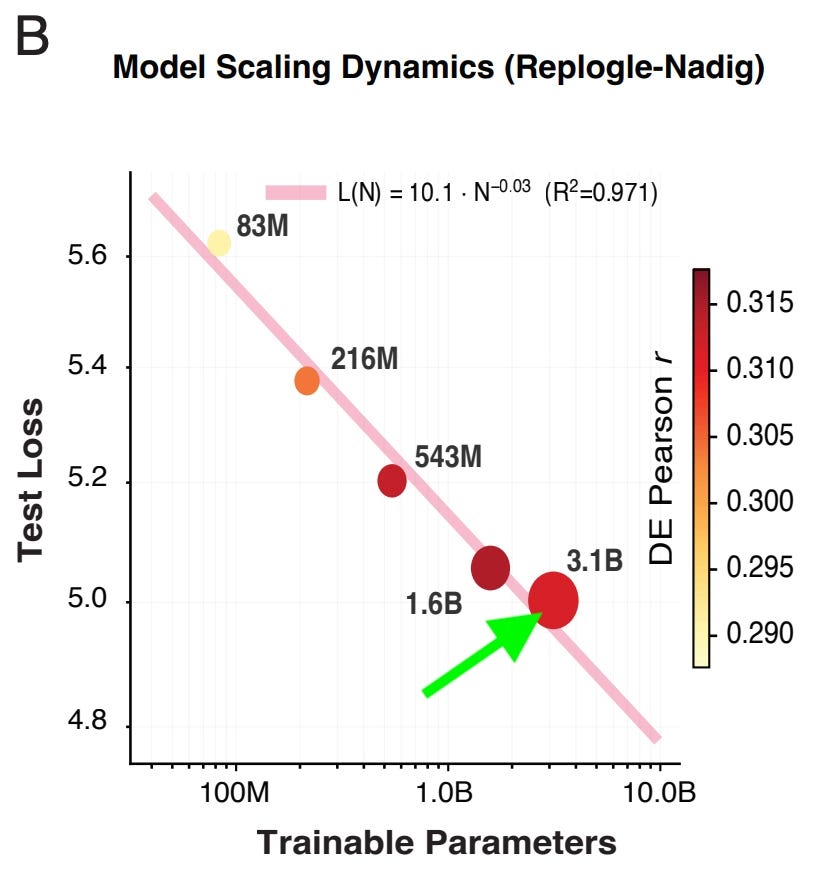
X-Cell outperforms linear baselines and other foundation models on perturbation prediction by training on massive causal Perturb-seq data (25 million cells, 7 genome-wide screens, 16 cell types).
The model uses a diffusion language model architecture to iteratively refine gene expression predictions, which is better suited for sparse, high-dimensional single-cell data than autoregressive models.
Key innovation: incorporating diverse biological priors (literature, PPI networks, cell type embeddings) as 'conditioning' to improve context-specific predictions and model interpretability.
The team demonstrates generalization from cell lines to primary human T cells and from resting to activated immune cells, showing the model's potential to predict in hard-to-experiment contexts.
The holy grail is a 'virtual cell' that can predict drug responses in humans, but it requires new technologies like non-destructive temporal sequencing and high-throughput proteomics.
"The main issue is we don't have the right biological data to power the training of a predictive model. In protein design, high-quality data over 70 years ushered in AlphaFold. In virtual cell, we are nowhere near that."
— Ci Chu
"What really blew my mind away is when I saw the model make prediction… line up the linear baseline prediction, the ground truth, and the XL prediction all together. It's visually very clear that XL prediction is much more similar to ground truth."
— Bo Wang
"Correlational data are underpowered to learn causality truly. We need causal data to train a causal model."
— Ci Chu