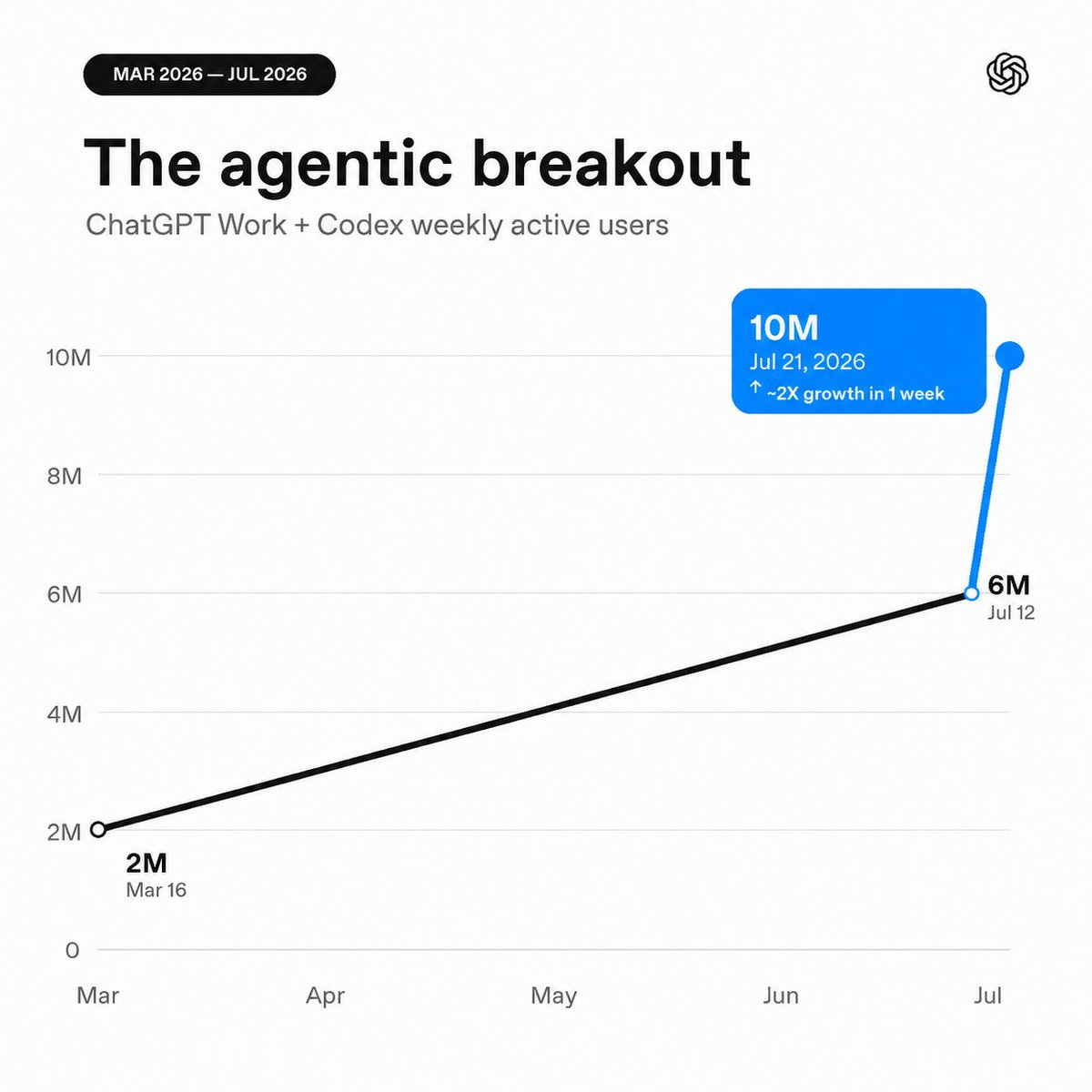
Akshay Nathan, OpenAI's lead for core product engineering, discusses the journey from ChatGPT Codex to the newly launched ChatGPT Work—a super app merging code-level power with conversational AI. He shares insights on enterprise adoption, the evolution of the product harness, and how the vision of 'bringing frontier intelligence to everyone' is becoming reality, with 10 million users in just one month.

Summarized by Podsumo
ChatGPT Work reached 10 million users in just one month, making it OpenAI's fastest-growing product by merging codex-level agentic power with conversational chat.
The product strategy is a sequencing: from developers (Codex) to general knowledge work (ChatGPT Work) to personal productivity (ChatGPT Life), with a unified harness that blends capabilities.
Memory (v3) and Chronicle create deep, personal context that persists across sessions, helping users feel like their ChatGPT is uniquely theirs.
Akshay defines productivity by 'at-bats'—the cycle of hypothesis, build, feedback, iterate—rather than proxies like code commits, and warns against conflating motion with progress.
The key insight for enterprise adoption is to 'show, not tell'—let users discover power through artifacts, sites, and computer use rather than documentation.
"_“The power of codex… the power of agents… we already had this massive distribution base of people who have come to know and love ChatGPT. How do we show that to them?”_ — Akshay Nathan"
"_“I think one piece of advice is to broaden your imagination of what’s possible. The technology has progressed so fast that something that three months ago was ‘no way’ is now ‘wow, it actually can.’”_ — Akshay Nathan"
"_“The most important thing we look at is at-bats: the ability to go from idea to validation efficiently, while staying motivated and excited throughout.”_ — Akshay Nathan"