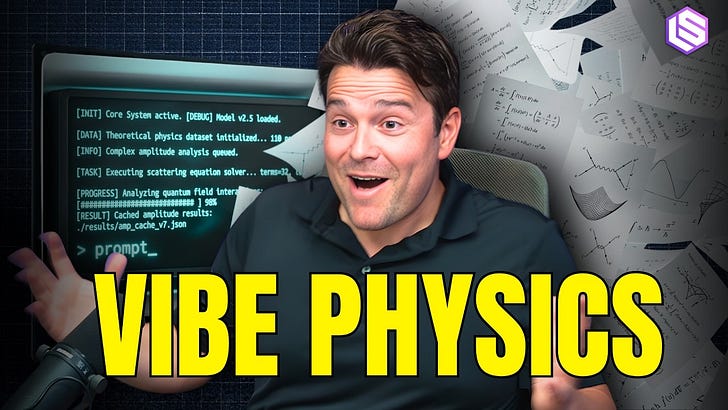
Alex Lupsasca from OpenAI discusses how AI, particularly GPT models, has achieved superhuman capabilities in theoretical physics, solving problems that stumped human experts for over a year. He highlights two recent papers on gluon and graviton amplitudes where AI not only simplified complex calculations but also conjectured and proved fundamental formulas, dramatically accelerating scientific discovery. This shift redefines the role of physicists, emphasizing human intuition for asking the right questions while leveraging AI for rapid computation and exploration.

Summarized by Podsumo
AI's Superhuman Physics Capabilities: GPT models, starting with GPT-3 and significantly with GPT-5, demonstrated the ability to perform complex theoretical physics calculations, saving days of human effort and even reproducing a researcher's best work in minutes.
Solving Open Problems: AI played a crucial role in resolving the "single minus gluon tree amplitudes" problem, conjecturing a simple formula (linear growth vs. factorial) that had eluded human physicists for over a year, and later an internal model proved it.
Accelerating Quantum Gravity Research: The "single minus graviton tree amplitudes" paper was completed in weeks, with publicly available GPT Pro performing the complex derivations based on the gluon paper, showcasing how AI can drastically speed up research, with human effort primarily focused on verification.
Transforming Research Workflow: AI acts as a "super-competent graduate student," reducing time spent confused and enabling researchers to "scout" multiple solution paths simultaneously, fundamentally changing how scientific problems are approached.
Future of Science: The discussion touches on the evolving role of physicists (focus on asking the right questions), challenges in training new scientists, and the potential for interactive, AI-powered scientific communication beyond traditional papers.
"AI was very useful for email, but not the kind of work that I do that I consider important theoretical physics calculations. I thought, oh, that's special. Much harder than email and AI is not going to be able to do that. Then there were a series of developments that came in rapid succession that completely changed my mind."
— Alex Lupsasca
"The amazing thing is that the formula that it proposed Instead of having this factorial growth, which is super exponential where the number of terms as you consider and a number of n of an increasing number n of particles the number of terms blows up here. It's actually linear so If you double the number of particles, you only double the number of terms. It's the nicest possible behavior you could imagine."
— Alex Lupsasca
"Most of the time, we spent verifying the answer, not deriving it, which is insane. Actually, if you told me a year ago, yeah, you're going to have this AI that just does really hard calculations for you. And then most of the human effort goes to verifying the answer. I thought that you know, you're crazy."
— Alex Lupsasca