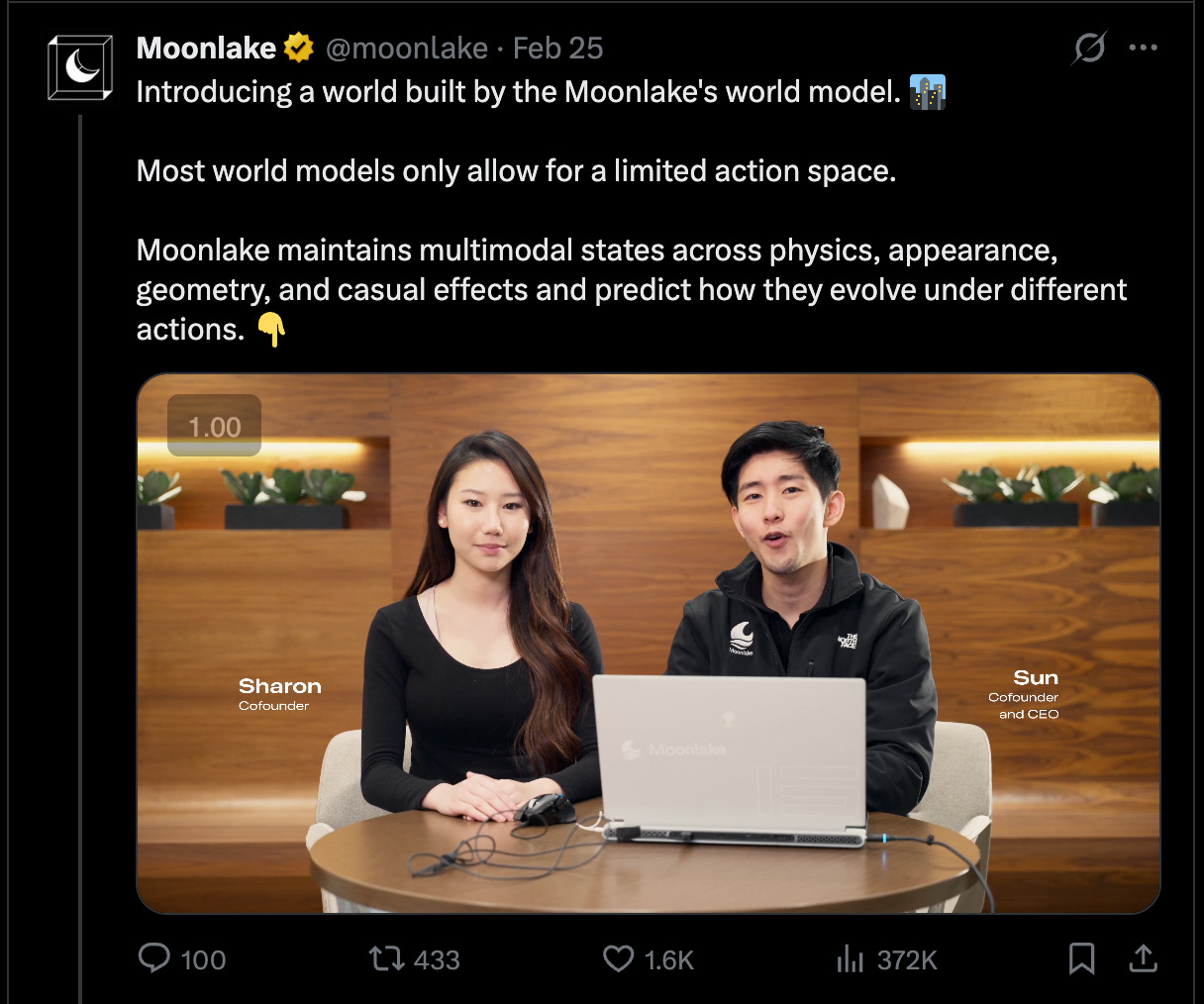
Moonlake introduces a novel approach to world models, emphasizing multimodal, interactive, and efficient causal reasoning over pure video generation. Their method combines a reasoning model for understanding world dynamics (geometry, physics, actions) with a diffusion model (Revery) for high-fidelity visual styling, allowing for structured, long-term consistent, and programmable virtual worlds. This approach aims to address the limitations of current vision models and provide a more controllable and adaptable platform for applications in gaming and embodied AI.

Summarized by Podsumo
Moonlake's models go beyond simple video generation by focusing on predicting the *consequences of actions* over long time scales, requiring a deep understanding of the 3D world and its dynamics.
The company advocates for *symbolic representations* and explicit structure (like geometry, physics, and affordances) to learn efficiently, contrasting with approaches that rely solely on scaling pixel-level data, which is crucial for real-time performance and long-term planning.
Moonlake employs a *multimodal reasoning model* for core causality, persistence, and logic, complemented by a *Revery diffusion model* to apply photorealistic or arbitrary visual styles, effectively separating the 'what happens' from the 'how it looks'.
Chris Manning highlights the *power of language and symbolic representations* as essential cognitive tools for advanced intelligence, a key differentiator from other visual-centric AI philosophies like Yann LeCun's.
"You need action condition world models that you only actually have a world model if you can predict given some action is taken what is going to change in the world because of that and in particular that becomes hard over longer time scales."
"We believe... that symbolic representations are powerful, and you want to use it in your understanding of the visual world, when you want to cause an understanding, when you want to maintain long-term consistency and prediction."
"The point I'm trying to make is that there are many, many different types of world simulators... But it's not as useful as people think when it comes to causal reasoning, when it comes to embodied AI."