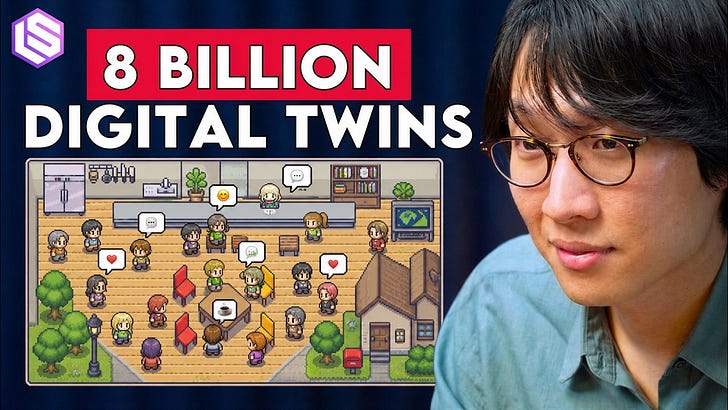
Joon Sung Park, CEO and co-founder of Simile AI, discusses how generative agents and simulation are creating a new scaling law for understanding human behavior. The podcast highlights his journey from artist to AI researcher, the impact of the 'Smallville' paper, and how Simile's behavior foundation models achieve 85% accuracy in replicating real people. The core insight is that simulation is about understanding causal mechanisms (how to change outcomes) rather than just prediction, with the ultimate goal of simulating 8 billion people to solve global challenges like climate change.

Summarized by Podsumo
Simile AI's models achieve 85% accuracy in replicating human behavior, far surpassing generic LLMs which score 20-60% on niche populations.
The key insight: simulation focuses on causal mechanisms (how to change outcomes) rather than just prediction, enabling counterintuitive strategic decisions.
Data for behavior foundation models requires three types: rich interviews, observational behavioral data, and causal data from randomized control trials.
The ultimate vision is to simulate 8 billion people to solve complex societal challenges like climate change, with scaling laws emerging as more data and compute are used.
"_"If you look at any advanced civilization in science fiction, there's two twin pillar technologies: one’s AGI in some form, and the other is simulation."_ — Joon Sung Park"
"_"What simulation can do is ensure that the voices of people is always represented in rooms where the decisions for them is made."_ — Joon Sung Park"
"_"The models that we’re talking about here… are models that are as dumb as I am. If I make such mistakes, the model has to make the same kind of mistake.”_ — Joon Sung Park"