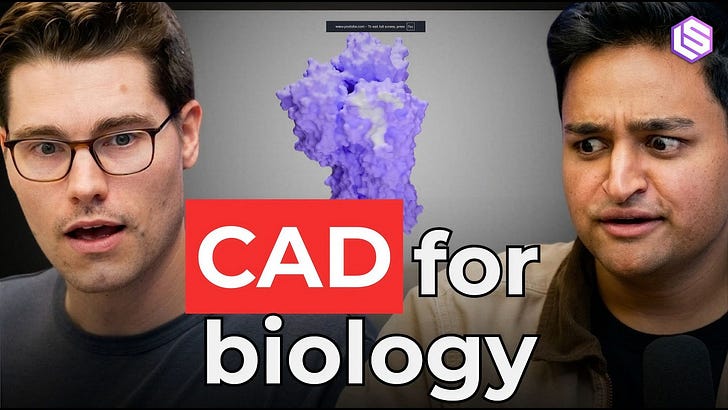
This episode explores how Chai Discovery is revolutionizing drug discovery by using AI models to design therapeutic antibodies from scratch. The founders discuss how their models have crossed the threshold of usefulness, achieving sub-angstrom accuracy in structure prediction and hit rates over 50% for antibody design, which is transforming drug development from a scientific experiment into an engineering discipline.

Summarized by Podsumo
Chai's AI can now design antibodies that bind to specific epitopes with precision, enabling new therapeutic modalities like GPCR agonists and multispecifics that were impossible with traditional methods.
The company's platform achieved a 0.33 angstrom error in cryo-EM validation, demonstrating near-atomic accuracy in predicting how designed antibodies interact with targets.
Chai is building a 'Photoshop-like' design suite for molecules, moving from traditional hit discovery to a agile, iterative loop where AI generates promising candidates directly.
The team emphasizes engineering simplicity and first-principles thinking, drawing parallels between ML challenges in protein design and core computer science problems.
"Our biggest competitor is the mouse. Traditionally, antibodies were discovered by infecting a mouse with a disease and seeing what it makes."
"We had a scientist who started crying after seeing our results because she had spent 10 years trying to get an initial binder to that target, and we helped her do it in months."
"In the 80s, one of the biggest venture outcomes was Genentech. Pharma is a VC business—taking ambitious bets on very valuable tokens."