Joseph Krause, CEO of Radical AI, discusses the critical role of self-driving labs in materials science, emphasizing that experimental data is the moat for AI-driven discovery. Unlike AI for biology, materials require capturing complex variables like supply chain, processing, and microstructure, which cannot be represented in simple strings. Radical AI's closed-loop system has produced 1,200 alloys in months, with 300 novel, and aims to compress the typical 15-30 year material development timeline through autonomous experimentation.

Summarized by Podsumo
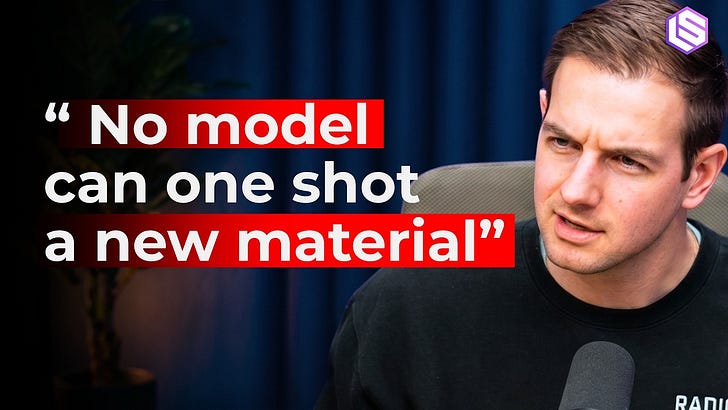
Joseph Krause argues that AI for materials is fundamentally different from AI for biology because materials require capturing complex, non-textual variables like supply chain, processing, and microstructure, which can't be represented in simple strings.
Radical AI's self-driving lab has achieved high throughput, making 1,200 alloys in five to six months, with 300 novel compositions and about 10 showing promising performance for industry applications.
The key challenge in materials science is the long feedback loop (15-30 years), which automated labs can compress by running parallel experiments and capturing data across the entire material lifecycle, from discovery to manufacturing.
"This is the difference between AI for bio and AI for materials... there is no one model that can one-shot a new material that ends up in your iPhone or Starship. That's just not the way materials work."
"If you can capture the data at the manufacturing side as well, now you have the whole suite of what we call like the lifespan of the material. That is the North Star of what the company wants to go out and do."
"In the self-driving lab, the AI scientist operates in parallel: it can read a hundred thousand publications and compare them to a hundred thousand SEM images at the same time in real time. A human scientist can't do that."