Anima Anandkumar, Bren Professor at Caltech, discusses the frontier of AI for physics, bridging data-driven deep learning with physical constraints through neural operators. She reveals how neural operators democratize weather and climate modeling by being tens of thousands of times faster than traditional simulations, and explains the need for foundation models that understand the physical world, not just language.

Summarized by Podsumo
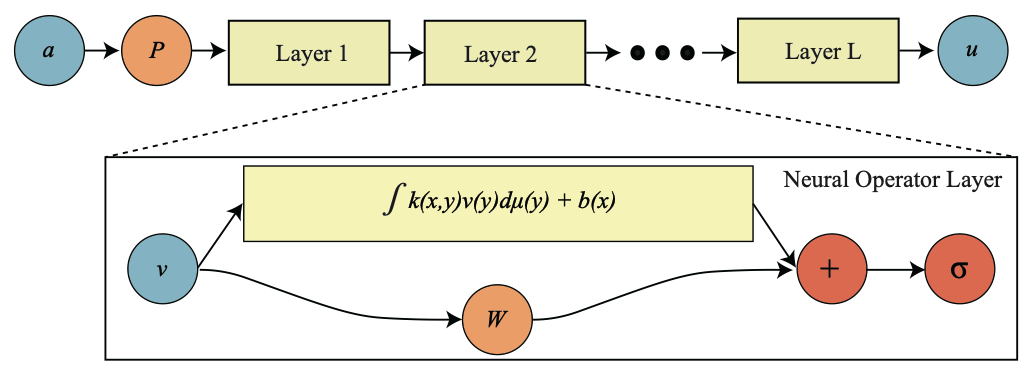
Neural operators, unlike fixed-resolution neural networks, learn continuous functions that can be queried at any resolution, enabling super-resolution and multi-scale physics modeling.
The Fourier Neural Operator (FNO) architecture captures non-local phenomena efficiently with quasi-linear complexity, avoiding the quadratic cost of transformers for high-dimensional physical data.
ForecastNet (weather model) trained on ~50,000 samples matches traditional weather model accuracy but runs tens of thousands of times faster on a consumer GPU, democratizing access for small weather agencies.
Incorporating spherical geometry into neural operators is critical for stable long-term climate rollouts—standard rectangular assumptions cause blow-ups in extended predictions.
TorchLean enables formal verification of neural network properties (like certified robustness) by writing neural nets in the Lean theorem prover, bridging deep learning and formal verification for safety-critical applications.
Anima emphasizes that AI for physics is distinct from language models—data is scarce, extrapolation is the goal (discovery), and inductive biases (geometry, physics constraints) are essential for reliable models.
Applications span fusion reactor plasma control, carbon sequestration simulation, aerodynamic design, inverse lithography, and quantum dot gate design—all using neural operators as a common framework.
"We have foundation models for language, not for physics. The idea is instead of narrow surrogates, we need broad models that work across phenomena, multi-physics, and coupled physics."
— Anima Anandkumar
"The physical world may be more forgiving for AI—extreme events have specific physical signatures. Nature helps us with structure."
— Anima Anandkumar
"Weather scientists said in 2021 that AI wouldn't beat decades of physics-based modeling, but we found it's not only accurate, it's tens of thousands of times faster."
— Anima Anandkumar