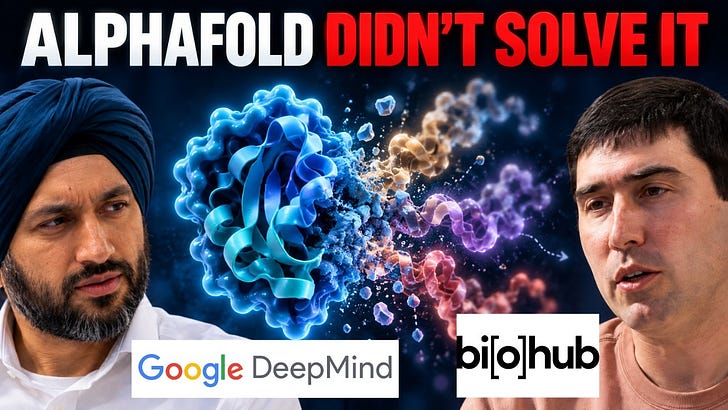
In this episode, Pushmeet Kohli from Google DeepMind and Sal Candido from Biohub discuss the limitations of AlphaFold, emphasizing that it didn't solve protein folding entirely—only static structure prediction. They explore the 'bitter lesson' for data, the balance between artisanal model design and scaling, and the importance of defining the problem before choosing data or modeling strategies. The conversation also touches on interpretability, AI in the clinic, and the need for bold, 10x approaches to accelerate translational medicine.

Summarized by Podsumo
The 'bitter lesson' for data: scaling works only if you have the right data with the right information statistics.
AlphaFold solved a specific problem (static structure prediction) but didn't address protein dynamics, function, or design.
Interpretability isn't strictly necessary but ensuring model trustworthiness (e.g., calibration) is critical for actionable decisions.
AI is already used in drug discovery, but a 10x acceleration requires better understanding of biological models.
The key is to be multidisciplinary: define the problem first, then choose data or modeling accordingly.
"If you are a multidisciplinary person, understand the problem first. Why are you working on this problem? What are we trying to achieve? — Pushmeet Kohli"
"AlphaFold solved the problem of replicating a structure deposited in the PDB. That does not mean we have understood all of protein dynamics. — Pushmeet Kohli"
"Sometimes it's easier to approach a problem by looking at what it's going to take to make a 10x improvement rather than a 10% improvement. — Sal Candido"