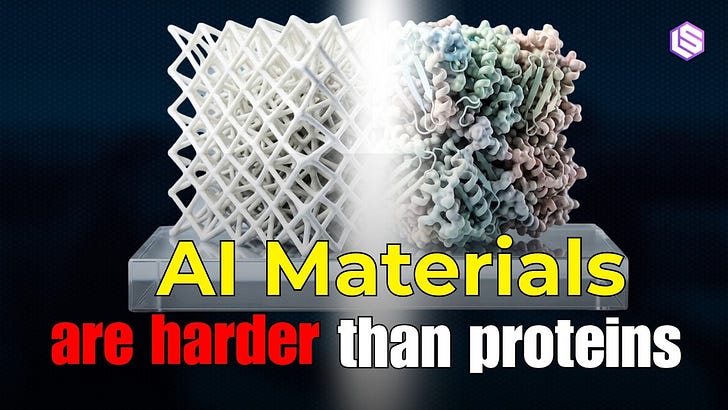
Heather Kulik discusses the transformative role of AI in accelerating materials discovery, showcasing how it led to a four-times tougher plastic by uncovering unexpected quantum phenomena. She highlights the limitations of current LLMs for complex chemical design and the significant challenges in achieving an "AlphaFold for Materials" due to the vast diversity of chemical bonding and the lack of high-fidelity experimental datasets. Kulik emphasizes active learning for multi-objective optimization and calls for rigorous validation of machine-learned potentials against physics-based models.

Summarized by Podsumo
AI-driven materials discovery led to a *four-times tougher polymer* by uncovering an unexpected quantum mechanical phenomenon, demonstrating AI's potential beyond mere acceleration.
LLMs currently lack deep chemical intuition, struggling with specific design tasks like generating a 22-atom ligand, indicating a gap between "Wikipedia-level" knowledge and expert-level problem-solving.
Active learning is key for multi-objective optimization, enabling rapid search for materials with complex trade-offs (e.g., *seven objectives* for CO2 capture materials), offering *100-1000x speedup per dimension*.
"AlphaFold for Materials" is challenging due to the vast diversity of chemical bonding, *more than 20 building blocks*, and a scarcity of large-scale, high-fidelity *experimental ground truth data* compared to protein folding.
Rigorous validation is needed for ML potentials to truly replace computationally expensive *quantum mechanical modeling*, as current models can be unreliable and only offer *~5x speedup* in some cases, not the *two orders of magnitude* required for a paradigm shift.
"Chatchy PT is super good at Wikipedia level chemistry knowledge. But one of my favorite things to actually throw at GPT as an anecdote is I'm really interested in molecular design... I can never get an answer that has 22 atoms."
"The real promise is going to be in searching for that needle in a haystack would say seven objectives and doing something where you're not waiting for the models to be accurate before you start doing that optimization that's really the promise of active learning."
"The challenge is that you have a lot more than 20 building blocks when it comes to materials. And so there's lots of different ways to think about chemical bonding. And right now no potentials are really robustly encoding all of that bonding, especially with respect to metal organic bonding."