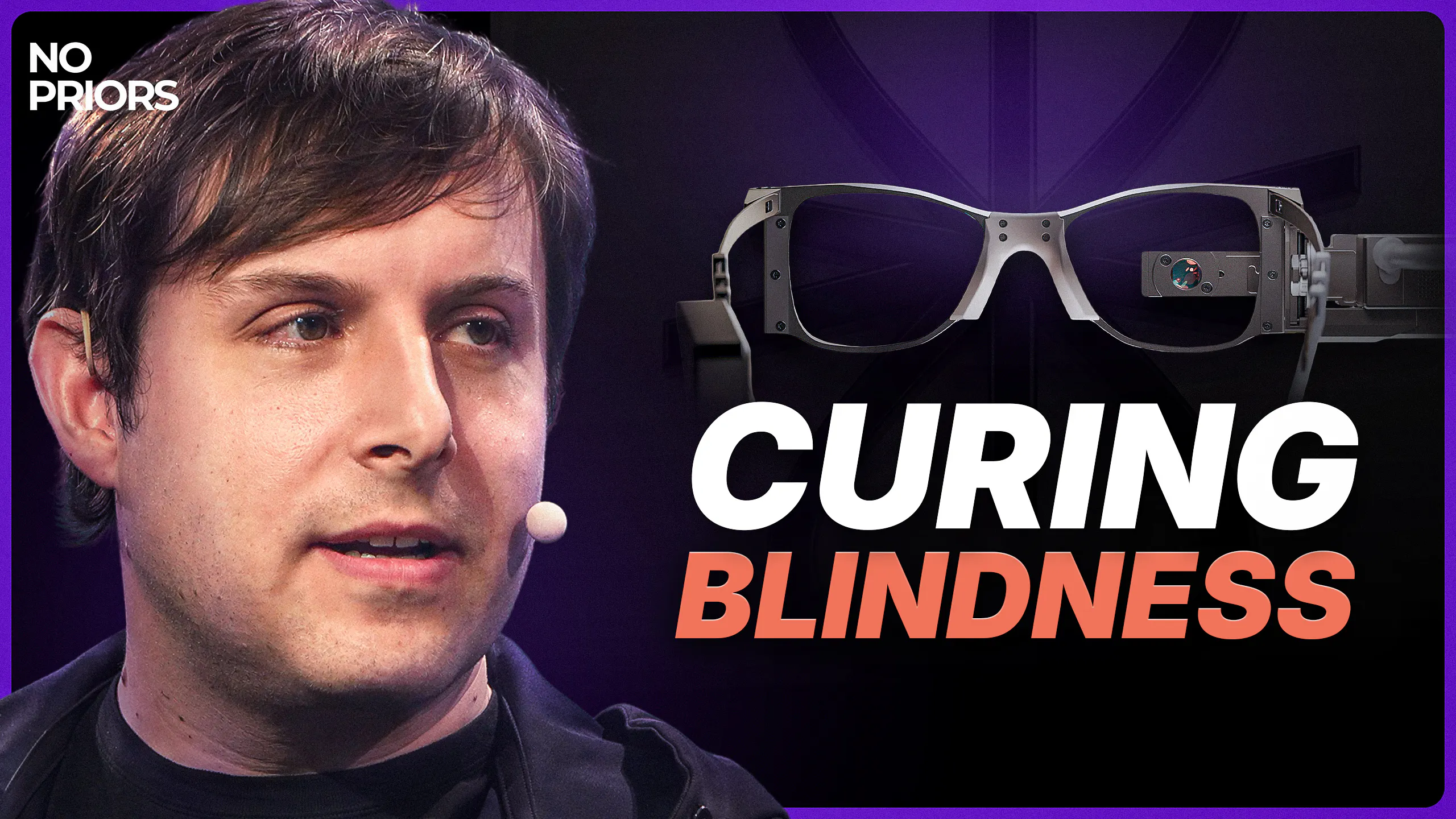
Max Hodak, founder of Science (formerly of Neuralink), discusses their retinal prosthesis Prima, which recently gained European approval to restore vision in blind patients. He argues that the brain is fundamentally a computer, advocates for substrate independence, and explores how AI models share structural similarities with biological brains, a concept known as the Platonic representation hypothesis.

Summarized by Podsumo
Science's Prima retinal prosthesis has received CE marking for commercial sale in Europe, restoring form vision (e.g., reading, Sudoku) to patients with macular degeneration, with plans to expand to other causes of blindness.
Hodak contrasts the predictable engineering progression of neural interfaces with the high failure rate of drug discovery, stating the brain as a computer is more amenable to iterative improvement.
He introduces the 'Platonic representation hypothesis,' noting that AI models and biological brains exhibit similar geometric representations, suggesting intelligence may be a fundamental law-like property of matter.
Hodak prioritizes restoring sensory signals (vision, hearing, balance) over high-bandwidth communication with AI, viewing the brain as a computer connected to the world via 'small cables' (cranial nerves), making sensory restoration a central goal.
He envisions reducing human fragility through replaceable body parts and substrate independence, ultimately enabling space exploration and solving major causes of death like cardiovascular disease and cancer.
"The brain very literally, very clearly, plainly is a computer. You can solve computational problems by arranging matter in a certain way and then like taking your hands off and pressing go."
"We talk about being a brain in a vat. That's what the skull is. Like the brain is connected to the environment through a small number of wires, the cranial and spinal nerves."
"If you can get the visual signal, auditory signal, balance motor, in and out of the brain, that is an end in itself. That is the central object."