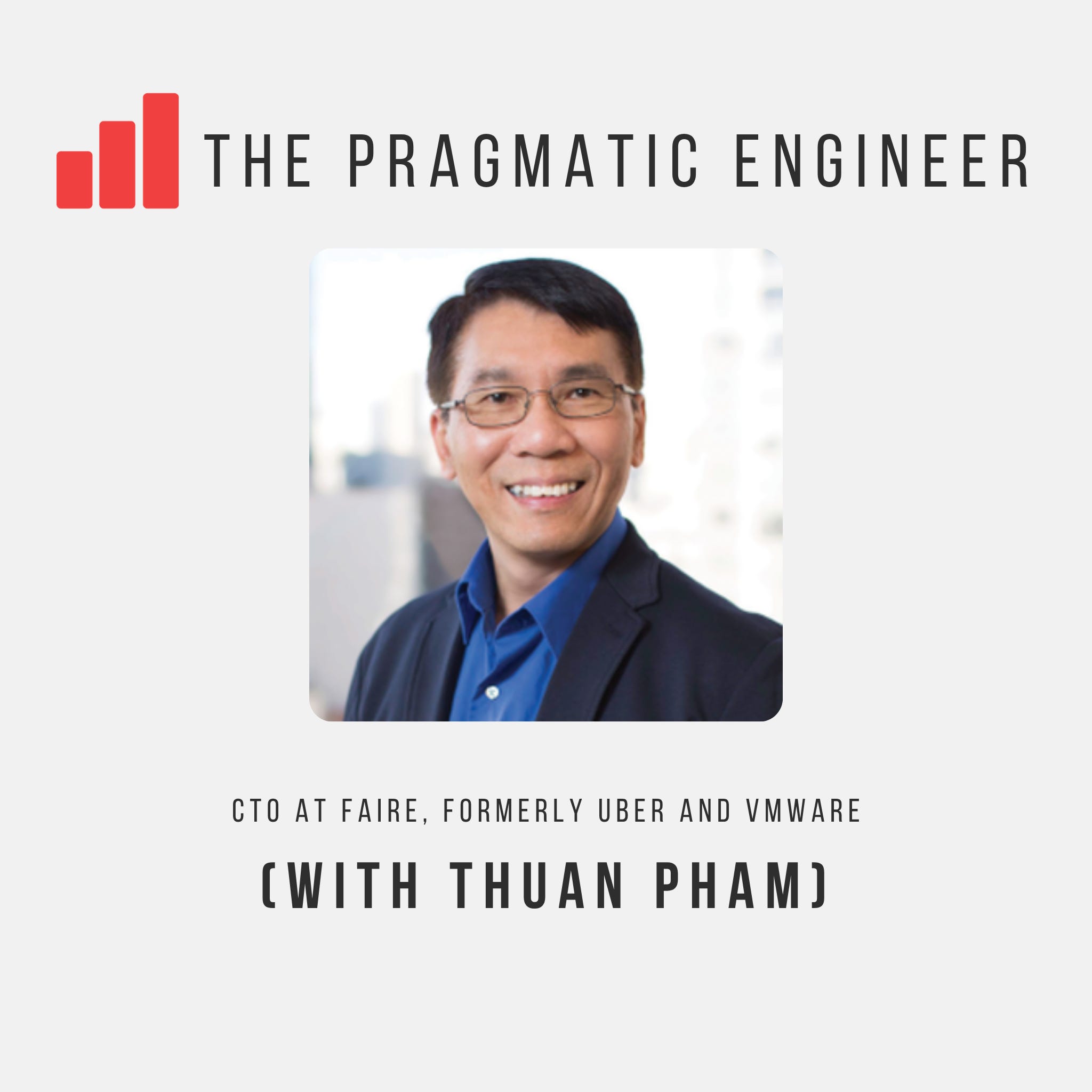
Thuan Pham, Uber's first CTO, recounts his journey from a Vietnamese refugee to scaling Uber's engineering organization from 40 engineers to thousands. He details the existential challenges of hyper-growth, including rewriting critical systems like dispatch, launching in China under impossible deadlines, and the necessity of building thousands of microservices and internal tools due to unprecedented scale. Pham also shares insights into Uber's unique engineering culture, organizational shifts, and his philosophy on leadership and continuous learning in a rapidly evolving tech landscape, including the impact of AI.

Summarized by Podsumo
Uber's early days were a constant race against system collapse, necessitating rapid rewrites of core systems like dispatch and the app (Project Helix) to keep pace with exponential business growth.
Uber's thousands of microservices emerged not from a grand plan, but as a survival mechanism to enable parallel development velocity when the monolith couldn't be decomposed fast enough.
Uber developed many proprietary tools (e.g., Yager, Schema-less) because existing open-source solutions couldn't handle Uber's extreme scale, highlighting the need for custom solutions in hyper-growth environments.
Thuan Pham's leadership philosophy emphasized building high-performance, cross-functional teams, fostering a culture of trust, and the CTO's role in anticipating future technical needs two years out.
While AI is rapidly changing software development, elevating the playing field, the core traits of great engineers—curiosity, innovation, and a willingness to stretch—remain paramount for exceptional impact.
"If you try to do a really good job at every company you've been working well with all the people that you work with, including your own team, your peer, whatever it is, over time very slowly you accumulate a decent reputation in people's mind."
"Complicency is death. I mean, like every one would move faster and faster. And the moment we stand still, we're falling behind."
"It's not a jail. We can lock anybody down. Now, I would have free will if they want to work, you know, somewhere, they should have their base to do that."